

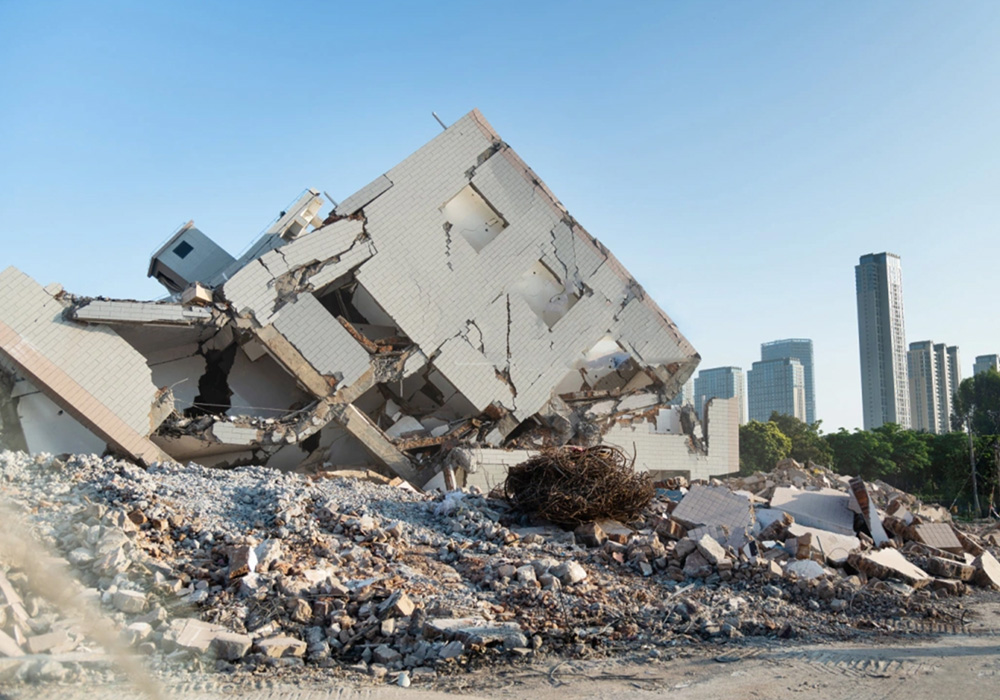
Global urban demolition and renovation projects generate billions of tons of construction and demolition (C&D) waste each year. Major countries such as the United States and China are now facing shrinking landfill capacity and mounting environmental pressure. Relevant research proves that 80% to 90% of typical C&D waste such as concrete, bricks, crushed stone and mortar can be processed into qualified recycled aggregates through crushing and screening. These end products are widely applied to road subbase, trench backfilling, recycled concrete and precast blocks.
C&D waste presents distinct processing characteristics and challenges for recycling operations. The material composition is highly complex, mixing concrete blocks, bricks, mortar, steel rebar, metal fittings, timber, plastic and glass all together. It contains a high level of contaminants, with lightweight debris and heavy impurities coexisting in the raw feed. The particle size distribution covers a wide range, from fine powder at millimeter scale to large lumps measuring several meters. Material hardness also varies greatly: C30-C50 concrete features a compressive strength of 30 to 50 MPa, while bricks are relatively porous with a compressive strength of only 10 to 20 MPa. The moisture content of C&D waste fluctuates significantly between 5% and 30%. Most importantly, the entire production process must comply with stringent local standards for dust, noise and wastewater treatment.
MP manufactures a complete line of core equipment including jaw crushers, impact crushers, feeders, screening machines and sand washing units. Professional C&D waste recycling lines are configured and customized based on raw material categories and end product applications. Three targeted technical solutions are introduced below to match diverse on-site conditions and business demands.
This solution is developed for overseas clients running urban demolition projects. Production facilities normally handle large volumes of waste concrete and brick-concrete materials, and most sites are located in urban and suburban areas with strict environmental regulations. Clients in this segment aim to produce recycled aggregates for road subbase and trench backfilling. The finished materials need to meet basic quality requirements, while strict standards for concrete-grade aggregates are not mandatory.
Three key operational difficulties commonly occur during production. Exposed steel rebar and iron wires in demolition waste easily wrap around crusher rotors and damage liner plates, which leads to unplanned downtime. Considering the high cost of on-site maintenance in overseas markets, frequent equipment shutdowns bring unbearable operational losses. Lightweight contaminants including wood chips, plastic and fabric cannot be fully removed via conventional processing. Many regional environmental regulations cap the impurity content of recycled aggregates at 1% to 2%. Excessive impurities will result in product rejection and regulatory fines. In addition, strict local restrictions on dust and noise apply to C&D waste treatment plants near residential areas. Public complaints over emissions will directly lead to production suspension, which requires a complete set of integrated environmental protection systems.
MP delivers a full set of targeted solutions covering anti-winding structure design, multi-stage impurity removal and comprehensive emission control. All jaw crushers are equipped with hydraulic tramp iron protection. The discharge opening automatically expands to expel uncrushable materials such as steel rebar. Impact crushers adopt an enlarged gap between rotor and housing to effectively reduce material winding risks. Manual picking platforms are installed at key material transfer points to remove long steel rebar before raw materials enter crushing equipment.
A multi-stage impurity removal process is adopted throughout the line. Magnetic separators are deployed ahead of primary crushing to remove large ferrous materials, and a second round of magnetic separation is arranged after primary crushing. Air classifiers are installed after screening to eliminate lightweight debris. MP provides professional support for the selection of externally sourced magnetic separators and air classifiers, alongside detailed process layout design services.
For environmental compliance, production is carried out in fully enclosed workshops equipped with pulse bag dust collectors that maintain a dust collection efficiency of no less than 99%, as well as spray dust suppression systems. All operating equipment is fitted with sound insulation enclosures to keep on-site noise within local limits. MP’s dust and noise reduction packages can be fully customized in accordance with local environmental laws.
The standard processing line is configured with PF inertial feeders or VGF bar feeders. With outstanding impact resistance, these feeders are well suited for conveying large-sized C&D waste. PEV/PEW jaw crushers with hydraulic tramp iron protection serve as primary crushing units to process concrete blocks and prevent equipment damage caused by steel rebar. Suspended magnetic separators and self-dumping magnetic separators, supplied separately, perform two to three stages of ferrous removal. PFC impact crushers work as secondary crushing units to process bricks and concrete and produce well-shaped aggregates. Positive and negative pressure combined air classifiers, also supplied separately, are responsible for removing plastic, wood chips and fabric. YK circular vibrating screens, LV linear vibrating screens or drum screens are used for material classification to produce recycled aggregates of different particle sizes.
This recycling line features a typical processing capacity ranging from 50 to 200 tons per hour. After complete processing, the ferrous removal rate exceeds 98%, and the lightweight material removal rate stands above 90%. The total impurity content of finished recycled aggregates is controlled below 1%, making the products fully qualified for road subbase stabilized materials.
This solution targets clients specialized in decoration waste treatment. Raw decoration waste contains a complex mix of plastic, gypsum boards, timber, fabric, metal and glass, which creates great challenges for pre-treatment. Most clients require highly automated sorting lines to cut labor costs and improve overall operational efficiency.
Three prominent challenges exist in decoration waste recycling. Raw materials feature diverse density and shapes, so manual sorting comes with low efficiency and high labor expenditure. Lightweight materials such as thermal insulation cotton, plastic films and rags tend to adhere tightly to the surface of aggregates. Residual lightweight contaminants cannot be eliminated thoroughly even with standard air classification, which severely undermines the quality of final products. Furthermore, automated sorting lines require considerable upfront investment in multiple types of equipment. Many clients worry that long payback periods will make it difficult to recover capital costs.
MP adopts a processing flow combining mechanical pre-sorting and deep purification. Drum screens are used for primary classification, dividing raw materials into large, medium and small fractions for subsequent treatment by air classifiers and magnetic separators. MP assists clients with the selection of externally sourced drum screens, air classifiers and magnetic separators, and delivers full-process layout design for the entire production line.
Two or three sets of positive and negative pressure air classifiers are deployed to remove the majority of lightweight materials. Density separators are applied in the final stage to conduct secondary purification based on density differences, ensuring the impurity content of final products meets regulatory standards. MP provides professional return on investment calculation based on clients’ estimated processing capacity and local market prices of recycled aggregates. Two equipment configurations are available to suit different budget plans: an entry-level setup with basic crushing and single-stage magnetic separation, and a standard setup equipped with complete multi-stage sorting systems. Clients are allowed to implement the project in phases according to capital arrangements.
The full production workflow starts with manual sorting platforms, while robotic sorting systems are available as optional outsourced equipment. Raw materials go through drum screens, multi-stage air classifiers and magnetic separators in sequence, before being processed by PFC impact crushers. Finished product screening and secondary air classification are conducted at the end of the line.
The typical capacity of this decoration waste recycling line ranges from 30 to 100 tons per hour. The overall material recycling rate reaches 60% to 80%, and the lightweight material removal rate is higher than 95%.
This solution is designed for overseas clients with mature and stable sales channels in the building materials industry. Instead of manufacturing low-grade aggregates solely for road construction, these clients aim to produce premium recycled aggregates for the production of recycled bricks, permeable bricks and C20-C25 recycled concrete, so as to lift product value and profit margins.
Three major difficulties hinder high-quality aggregate production. Recycled aggregates produced by conventional crushing lines have a crushing value of 25% to 30% and a water absorption rate higher than 10%, which fails to meet the standards for concrete production. Most clients lack practical experience in high-end aggregate production, so they cannot confirm whether finished products will qualify for recycled brick or low-grade concrete production even after purchasing shaping and washing equipment. Additionally, wet processing generates large volumes of sludge, and the dewatering and dry disposal of sludge will add extra operational expenses.
MP upgrades standard demolition waste processing lines by adding dedicated units for aggregate shaping, washing and deep impurity removal. VSI vertical shaft impact crushers are installed for aggregate shaping to reduce flaky and elongated particles. XSH sand washing and recovery machines are deployed to lower the mud content of materials, while externally sourced density separators are used to remove residual lightweight particles. These upgraded units effectively improve aggregate cleanliness and particle shape. It should be noted that the final crushing value and water absorption rate are mainly determined by the inherent physical properties of raw C&D waste.
MP clearly defines the service scope and technical capabilities. The company is responsible for crushing, shaping and washing to produce aggregates with qualified particle sizes, and provides complete and authentic technical parameters for reference. The application range of finished aggregates for specific concrete grades is determined by clients in accordance with local industry standards and on-site testing. MP does not make unconditional promises that finished aggregates are fully applicable to C25 concrete production.
For sludge treatment, XSH sand washing and recovery machines are equipped with built-in fine sand recovery and dewatering functions. All sludge is processed into dry cake via filter presses, and all process water is recycled for repeated use. MP offers professional support for filter press selection and can recommend reliable equipment suppliers.
Only three core devices need to be added to existing demolition waste lines for upgrading: VSI vertical shaft impact crushers for aggregate shaping, XSH sand washing and recovery machines for mud reduction, and externally sourced density separators for residual light material removal.
The upgraded high-value aggregate line has a typical processing capacity of 50 to 150 tons per hour. Finished recycled aggregates deliver a crushing value below 25% and a water absorption rate under 8%, fully complying with production requirements for recycled bricks and low-grade recycled concrete.
Standardized operation and routine maintenance are critical to stable line performance and consistent product quality. All on-site sorting personnel must receive professional training to accurately identify and separate various contaminants. As primary responsible parties, construction contractors and plant operators are required to specify detailed measures for waste reduction, classification, collection, transportation and pollution control in official construction documents.
Daily maintenance is required for all magnetic separation units. Ferrous materials attached to the surface of magnetic separators must be cleaned every day to keep the magnetic field strength at no less than 1500 Gauss. Self-dumping magnetic separators run automatic iron removal procedures 3 to 5 times per shift to prevent magnetic attenuation caused by accumulated ferrous debris.
Air classifier parameters need timely adjustment according to real-time material composition. When the proportion of lightweight contaminants rises by 10%, airflow volume shall be increased by 15% to 20%, to maintain a lightweight material removal rate above 95%.
For environmental protection equipment, filter bags of pulse bag dust collectors must be cleaned or replaced immediately once the pressure differential exceeds 1500 Pa. Spray dust suppression systems are activated when on-site dust concentration exceeds 20 mg/m³, with a target to keep the concentration below 10 mg/m³ at all times.
Regular quality inspection is enforced for finished recycled aggregates. Sampling tests covering impurity content, crushing value and particle gradation are carried out for every 2000 tons of finished products. The total impurity content is required to stay below 0.5%. Once test results go out of limits, operating parameters of air classifiers and density separators will be adjusted promptly.
Zero wastewater discharge is implemented throughout the plant. Sludge in sedimentation tanks is transported to dry disposal systems every shift. Supernatant water from sedimentation tanks is recycled as process washing water, and the solid content of recycled water is controlled below 5%.






Long Press to Scan QR Code
Scan QR Code